Why organisational latency is becoming the biggest barrier to fully realising AI’s benefits
Executive Summary
- Productivity gains have limited value if work still moves through the same committees, approvals, handoffs and functional silos. The constraint increasingly becomes organisational latency: how long it takes an organisation to make decisions, change processes, and turn new capabilities into business outcomes.
- Work that previously required multiple specialists, departments or weeks of effort can be completed dramatically faster. This changes how teams collaborate, how decisions are made and where expertise is needed.
- The benefits are realised fully when organisations revolutionise their design, thinking differently about workflows, governance, incentives, knowledge flows and decision-making structures so that AI-driven productivity gains compound across the enterprise.
- AI-native orgs need both a stable backbone and an adaptive edge, while harnessing the most valuable human skills on judgement and orchestrating actions.
There is a lot of discussion on LinkedIn, Substack and other forums that amount to “I cant see the ROI on AI”. As meaningful adoption takes off, we see plenty of ROI on AI solutions and adoption of off-the-shelf tools like ChatGPT, Codex, Claude. But still, the point is understandable. While sizeable individual productivity gains are possible, they’re ultimately constrained if the workflows in an organisation remain the same. Your organisational design needs to evolve.
Unfortunately however, you cannot future-proof an organisation, particularly given how quickly AI is moving. Nobody can say with confidence what an AI-optimised bank, insurer, retailer, energy company or consultancy should look like in three years’ time. The technology, economics and patterns of work are changing too quickly, making the ability to adapt one of the defining advantages of the next decade.
But if you have expert-level intelligence available instantly and AI agents can work autonomously for hours, then you have to assume how work gets done will, and should change. And that suggests your operating model has to change to benefit from the technology. The organisations willing to adapt most quickly to new patterns of work and emergent applications of this technology stand to gain the most.
Assume Expert Intelligence is Instantly Available, Leveraged by Autonomous Agents
The easiest way to understand the organisational impact of AI is to start with a simple assumption. Assume expert-level intelligence is instantly available to anyone in the organisation. This was difficult to imagine two years ago, but now is pretty much reality already. And while it may not be perfect yet, it seems reasonable to assume it will be close to perfect in the very near future.
Add to that, a second assumption. Assume autonomous agents can work together for hours, days and eventually weeks to complete meaningful bodies of work. Not a task or a few tasks, but an actual substantial sequence of work across multiple disciplines. A cross-functional team wrapped up in a team of agents capable of figuring out the workflow for themselves.
If both of those things are even directionally true, then how work gets done will (have to) change. Time to completion shrinks, the shape of collaboration internally evolves, the pace of change accelerates.
Change at this pace favours decentralisation, autonomy and innovation, while most large organisations are built around the opposite idea.
Most Organisations are Designed to Slow Change Down
Large enterprises centralise power in function-aligned departments. They separate strategy, technology, data, risk, operations, finance, HR and the business into different structures, each with its own priorities, incentives and, most importantly, controls.
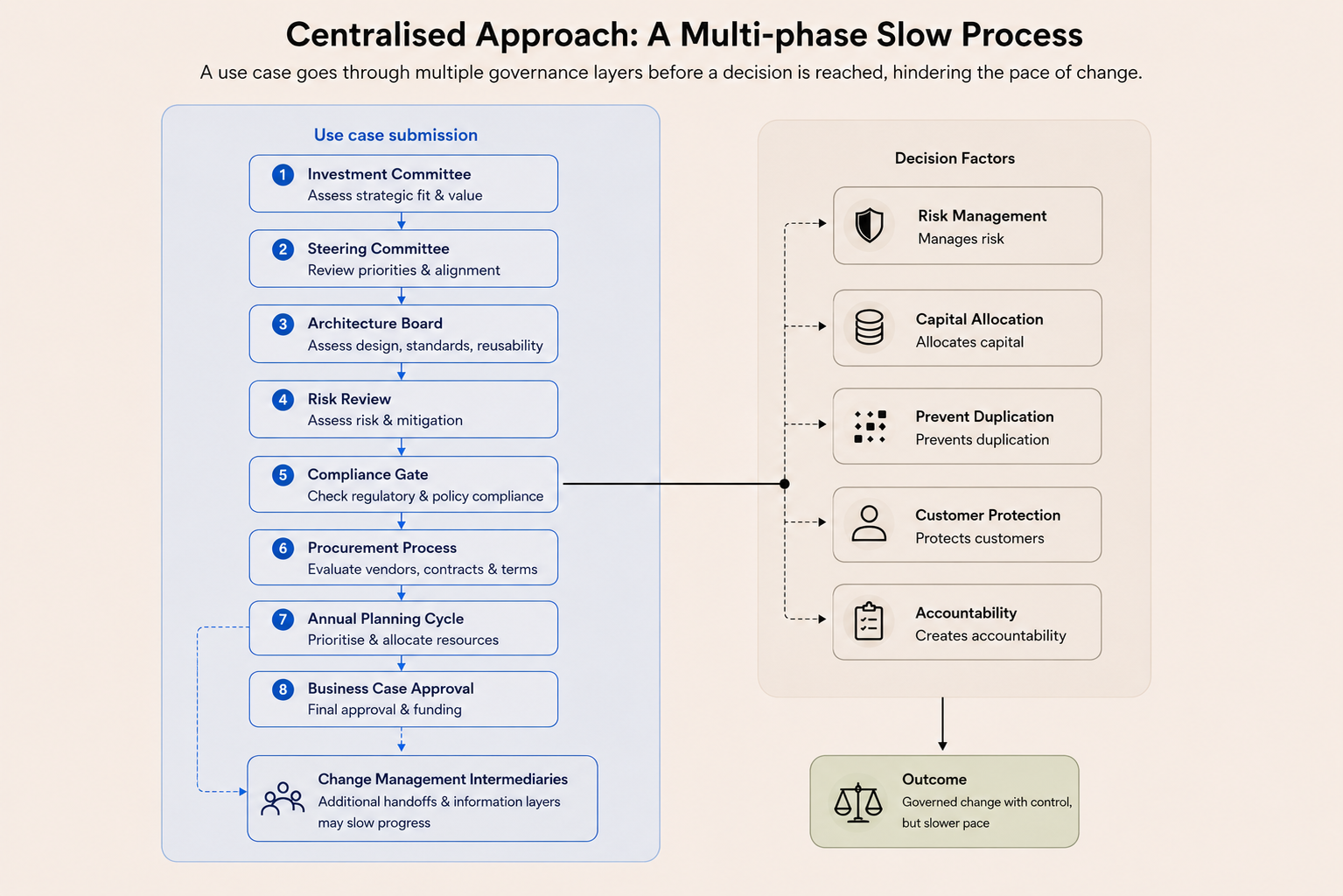
Investment committees, steering committees, architecture boards, risk reviews, compliance gates, procurement processes, annual planning cycles and business cases govern change. Some change management teams further intermediate information between stakeholders without adding value to it.
Again, none of this is irrational and these mechanisms exist for good reasons. While they manage risk, allocate capital, prevent duplication, protect customers and create accountability, they also set a pace. That is likely to be too slow for a world where AI-native competitors can test, learn and redesign work much faster.
The cultural signal matters too. In many organisations, incentives still reward staying inside functional lines, no matter how often a leader says "you are empowered to make decisions". Why? Protect the team. Protect the budget. Protect the roadmap. Avoid visible failure. Escalate difficult decisions to a committee. Do not step too far outside the approved process.
This centralised approach makes sense when the cost of experimentation is high and occasional change is evolution rather the revolution pace. But it becomes a problem when capability is improving substatially every few months and the best opportunities are discovered by teams close to the work.
Responding to AI with traditional centralisation creates a latency that blocks meaningful ROI. If every change has to move through multiple committees before it touches real work, the organisation will learn too slowly.
For your people who want to grow and move more quickly, limiting opportunities to leverage AI makes you a less attractive place to work.
Individual AI Fluency -> Team AI Fluency -> AI-native Organisation
Most organisations are starting with individual AI fluency. That is the right place to begin. People need to know how to brief AI, how to challenge it, how to check its work, how to protect sensitive information and when not to use it. They need confidence, judgement and practical experience.
But individual fluency has a ceiling. An analyst can produce five times more analysis, but the decision forum still meets monthly. A developer can generate more code, but the review and release process has not changed. A marketer can create more content, but brand approval still sits in the same queue.
Even at the team level, a change in workflow doesn’t necessarily equal increased velocity if other parts of the organisation still operate in the same way they always have.
So the individual moves faster, the team may move faster, but the output velocity is constrained by other parts in the end to end flow in the organisation. That is why the AI journey has to move from individual fluency, to team fluency and onward to organisational fluency.
When the enterprise can change its structures, incentives, governance, knowledge flows and technology patterns, those local gains made by individuals and teams become enterprise value.
That is a hard challenge, but that is where the opportunity to unlock value is. For AI-native firms born in the last few years after the release of ChatGPT built workflows with AI already embedded, they remain nimble and operate with flat structures. By contrast, larger enterprises have inserted AI into existing processes, causing a patchwork effect that fails to change how the work is done.
A Stable Backbone and Adaptive Edge: What it Means to be AI-native
AI-native does not mean chaotic, reckless or tool-obsessed. It does not mean every employee using the latest model in whatever way they choose. And it certainly does not mean replacing governance with enthusiasm, nor pretending humans are no longer needed.
The old model of organisation design assumes you can define a future state, draw the structure, implement the change and stabilise. That is too slow for AI.
AI-native organisations will be designed for continuous change. An AI-native organisation is one that continuously redesigns work around the combined strengths of people, AI systems, data, workflow and governance. They will not bet everything on a single blueprint. They will build the capacity to find out quickly: which workflows should change, which roles need to evolve, which controls are needed, which skills matter more, which patterns can be reused and which assumptions are already out of date.
That requires two things at once: a stable backbone and an adaptive edge. These provide a balance between centralisation and empowering teams close to the work.
The stable backbone gives the organisation trust and scale. The entire business has access to approved tools, reusable patterns, data access routes, evaluation methods, security controls, governance principles, monitoring, knowledge infrastructure and clear ownership.
The adaptive edge is where the work happens and changes frequently and frictionless. Small, cross-functional teams close to the problem have enough authority to redesign workflows, apply AI, test new ways of working and feed learning back into the organisation.
That balance between the core and the edge is important. Too much central control and the organisation learns too slowly. Too much local freedom and the organisation fragments. The AI-native organisation needs discipline at the core and adaptability at the edge.
The lazy conclusion of automating work is that AI reduces the need for people. In some areas it will, such as low-context, repetitive knowledge work that will be compressed or removed. Work that is mostly transactional, covering for gaps in systems, moving information, initial analysis, producing first drafts, and limited 'value add' responses will all be under pressure.
But the flip side of that coin is that the human 'contribution' moves up a level: if expert intelligence is instantly available, the scarce human qualities that AI cannot and should not replace become judgement, creativity, accountability, context and trust.
Organisations should increasingly focus on people who can make decisions in ambiguous situations. People who can understand the domain deeply enough to steer AI and know when it is wrong. People who can ask better questions. People who can connect commercial, technical, operational and human realities. People who can build relationships, create confidence and orchestrate between many stakeholders. And, importantly, the ability to context-switch and interpret information rapidly and correctly becomes more essential when you imagine a week’s worth of work gets compressed into your Monday morning.
So, generalists become more valuable, not less, if they can hold context across functions and coordinate AI-enabled work. Experts may become more valuable, not less, because faster work creates more moments where quality and judgement matter. And leaders will need to become less like controllers of activity and more like designers of systems, context and pace.
The skills to invest in are not only “AI skills”. They are the human characteristics that become more important when AI handles more of the low-level task execution: curiosity, judgement, resilience, clarity, creativity, decisiveness, collaboration and comfort with ambiguity. The organisation should be hiring, developing and rewarding those characteristics now.
Compressing this much work is intense and AI-native organisations can’t operate at breakneck speed 100% of the time. They’ll need to create bandwidth and slack for people to recover and reconnect. To judge and decide effectively, organisations should foster environments where serendipity might lead to novel new ideas.
The Inflection Point is Coming
Today, many enterprises are slow to use AI for what is already possible. This creates a widening gap between improvements in agentic capability and improvements in its use.
That is normal. Large organisations absorb technology slowly thanks to legacy systems, regulatory constraints, cultural resistance, fragmented data, unclear ownership and genuine risk that all require managing.
But at some point, enough leaders, teams and competitors will work out how to apply AI to real workflows safely and repeatedly. Patterns will mature, governance will become more embedded, agents will become more reliable and organisational confidence will grow. The gap between what AI makes possible and what enterprises actually use will start to close.
When that inflection point arrives, the advantage will not go to the companies with the best models or the biggest AI budgets, but to those organisations that can change how work gets done at pace.
The companies that centralise every decision, protect every function, govern through slow committees and reward people for 'not rock the boat' will struggle to keep up.
The companies that build a strong backbone and an adaptive edge will learn faster. They will discover better workflows earlier, they will redeploy a healthy mix of generalist, expert and leader human talent towards higher-value work, and they will turn local experiments into reusable patterns.
The Focus for Leaders
The question for now may be "How do we adopt AI successfully?", but soon that has to change to "How quickly can our organisation adapt as AI changes the work?"
A slow organisation with powerful AI will still be slow, an adaptive organisation with powerful AI will compound.