Agentic Retail: When Customer Journeys Start with Intent, not Search
Retailers that adapt can remain highly valuable by becoming the most trusted and effective fulfilment layer for customer intent
We're exploring the future of industries with applied AI. As part of this series we've taken a deep dive into retail and explored how customers will engage with businesses in the future. This blog shares some of our opinion and thinking. We’re still building the future, so treat it as provocation rather than a final answer! If you find it interesting, we'd love to chat on info@tomoro.ai
Executive Summary
- Agentic retail will shift the battleground from winning traffic to being chosen by an AI agent acting on a customer’s behalf. Retailers need to be clear on their role in that journey, why they’re the best answer to customer intent and how agents understand them.
- Ultimately, the winners will be those that combine a sharp proposition with reliable execution and trustworthy, agent-compatible infrastructure.
- Retailers may no longer be the focal point of the journey but those that adapt can remain highly valuable by becoming the most trusted and effective fulfilment layer for customer intent.
For decades, retailers have competed for the same scarce prize: customer attention. They poured money into stores, websites, apps, loyalty schemes, search rankings, retail media, CRM journeys and personalised recommendations, all chasing a single goal — to own the customer journey from discovery , browsing, comparing and buying. That world, however, is beginning to change, and the next customer interface may not be a retailer's website, a search engine, or even a marketplace but an agent.
Picture a personal AI assistant that understands what the customer is trying to achieve. This sort of thing already exists in some form. It researches options, weighs trade-offs, checks availability, recommends the best route forward, executes the transaction and manages the follow-up. It does all of this not because the customer has searched for a specific product, but because the customer has expressed an intent:
"I need a family beach holiday in October with good weather, culture, direct flights, less than 5 hour flight and a 4 star hotel that works for two children."
This is the shift from retail as a destination to retail as an execution layer. The agent increasingly owns the front of the journey — search, discovery, comparison and even some of the actions along the way — while the retailer retains the moment that still matters most: the final execution of the purchase. The work of finding, weighing and shortlisting moves to the agent; the work of fulfilling the intent stays with the retailer. This has major implications for where retailers sit in the customer journey of the future.
The Signs are Already Here
This is not simply a technology shift being pushed by platforms but a response to changing consumer behaviour. Research shows over half of US adults use AI to find ideas and make purchases – and more are taking recommendations from assistants.
Tech platforms are catching on. OpenAI’s Agentic Commerce Protocol allows ChatGPT to ingest catalogue data and merchant inventory to surface products directly to users, and launched Checkout, built by Stripe, so users can make purchases from within the chat interface, without ever visiting the retailer’s site.
Google has taken similar steps to standardise communication between agents and retail systems alongside Shopify, Walmart, Target, Wayfair and Etsy. Payments are also shifting, with Visa embedded into ChatGPT payments to ensure purchases are within spending limits and approvals.
Clearly the groundwork for a new commercial architecture is being laid. One where agents can understand intent, query retailer systems, exchange information, pass payment instructions and complete tasks on a customer's behalf.
From Search to Intent
Traditional search forces customers to compress their need into keywords so they can get relevant results. You had to know the best way to search for what you want, reducing a complex situation to phrases like "family hotel Algarve October."
But real customer needs begin as multi-faceted situations. Let’s take a family holiday as an example, "We want a warm family holiday, but we don't want a resort that feels like it could be anywhere."
Agents are suited to these less rigid and more human prompts. They can ask follow-up questions, hold context and turn a vague goal into a concrete set of actions.
For retailers, that changes the nature of the signal they receive. Today, a retailer understands a customer’s behaviour through products clicked, baskets abandoned, emails opened, and purchases made on their site. In an agentic journey, the signal is richer and more revealing. It is no longer just "this person viewed a hotel," but "this person is comparing three holiday destinations, has already researched travel and transfers, is worried about facilities, and is now asking for the best available offer before booking." That is far more valuable commercial context, and at least in the short term, agentic commerce should be treated as a genuinely new source of intent and not merely another checkout integration.
The New Agentic Channel
The agentic channel will sit upstream of paid search, organic search, marketplaces and affiliate traffic. The customer may never type a query into Google, never land on a category page, and never browse ten retailer websites, because their agent will do that work for them. As a result, the retailer's challenge shifts from "How do we rank for this keyword?" to "How do we become the best answer to this customer's intent?"

An agentic journey in practice: once intent is known (here, “we’ve booked a family holiday”), the assistant quietly completes the low-friction admin. It captures key details, checking calendars, adjusting weekly shopping, prepping FX and roaming, before surfacing only the choices that need judgement, money, or approval from the user.
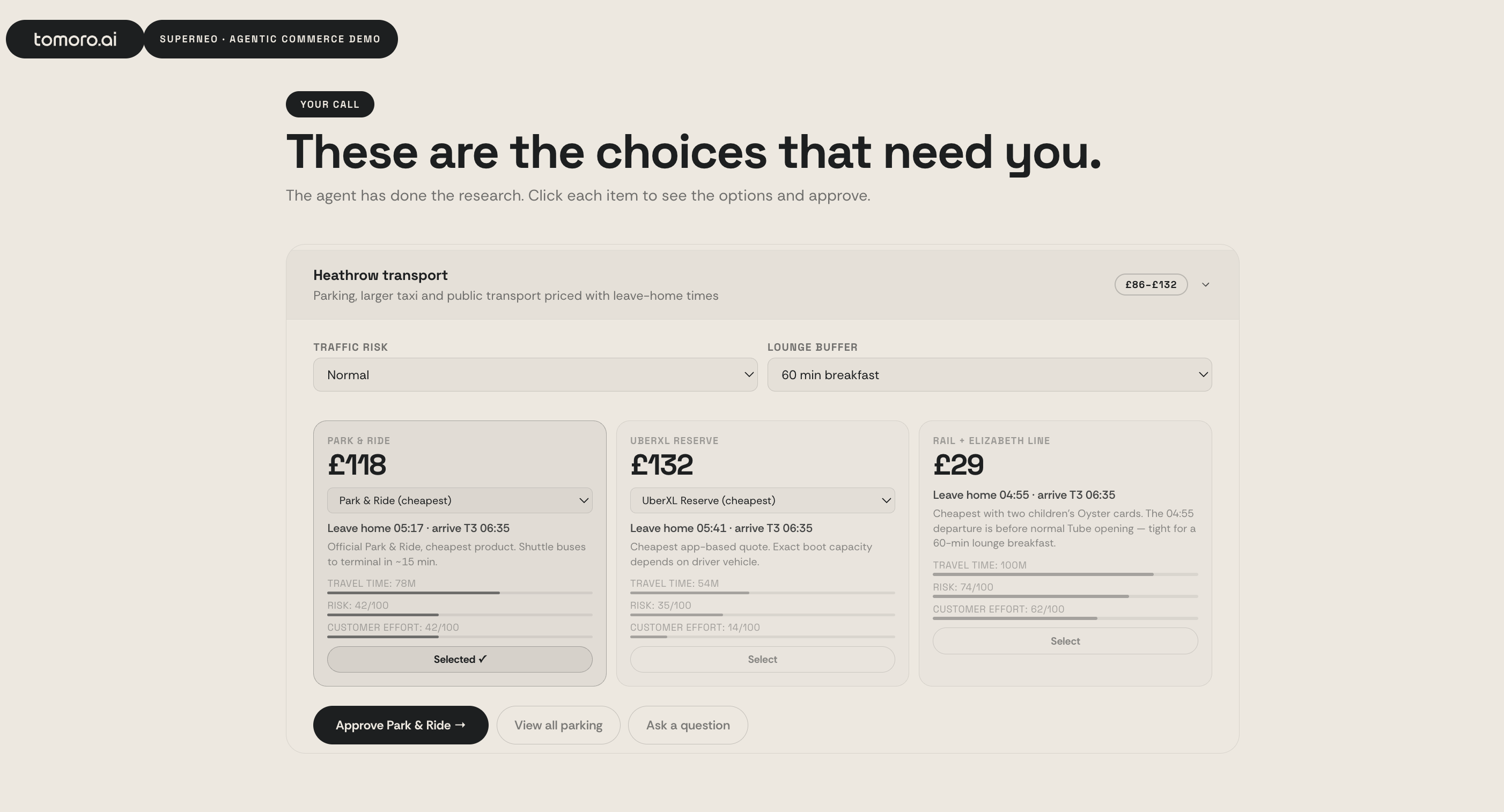 After doing the research and narrowing the field, the assistant hands back only the high-stakes decisions—clear options, trade-offs, and prices—so the customer approves what matters while the agent executes the rest. In this case, that’s comparing its transfer to the airport against multiple journey time, effort and risk.
We built a working prototype to show how this could look for customers, explore it here.
The key idea is an intent-led ecosystem where retailers and service providers work together around the customer's real-life context. The experience shifts retail from isolated transactions into a joined-up journey planner: each brand contributes the part it knows best, while the customer sees one clear list of actions, decisions, and completed tasks.
Agents are Functional – Brands are Emotional
Agents are exceptionally good at functional assessment. They can compare specifications, summarise reviews, check prices, inspect delivery promises and identify the product that best matches a stated need. This will make retail more transparent — and, in places, more brutal. If the customer's agent is running the first round of selection, weak propositions will be exposed quickly, and products with poor data, unclear policies, slow fulfilment or vague differentiation may simply never make the shortlist.
Yet retail has never been purely functional. Brands matter because people do not only buy products; they buy confidence and belonging. That is why retailers still need to bring customers into their own environments when it counts. The future, then, is not about letting agents complete everything inside someone else's interface. It is about knowing when the agent should complete the task, and when it should route the customer into a richer brand experience.
Your Digital Assistant Handles the Admin, Asks When it Matters
The deepest shift is the agent quietly orchestrating an entire ecosystem of retailers and services around moments in a customer's life, such as a holiday. An agentic assistant could:
- Book airport transfers and update based on potential delays
- Pause recurring deliveries and reschedule an essentials delivery for their return
- Prebook your mobile data package needed for your destination
None of these actions is dramatic on its own, but together they represent a profound change in the customer relationship. The customer expressed a single intent — "I have booked a holiday” — and an agent orchestrated an ecosystem of retailers and service providers responded in concert, each one accessible to the agent and each one contributing a small, useful piece of work.
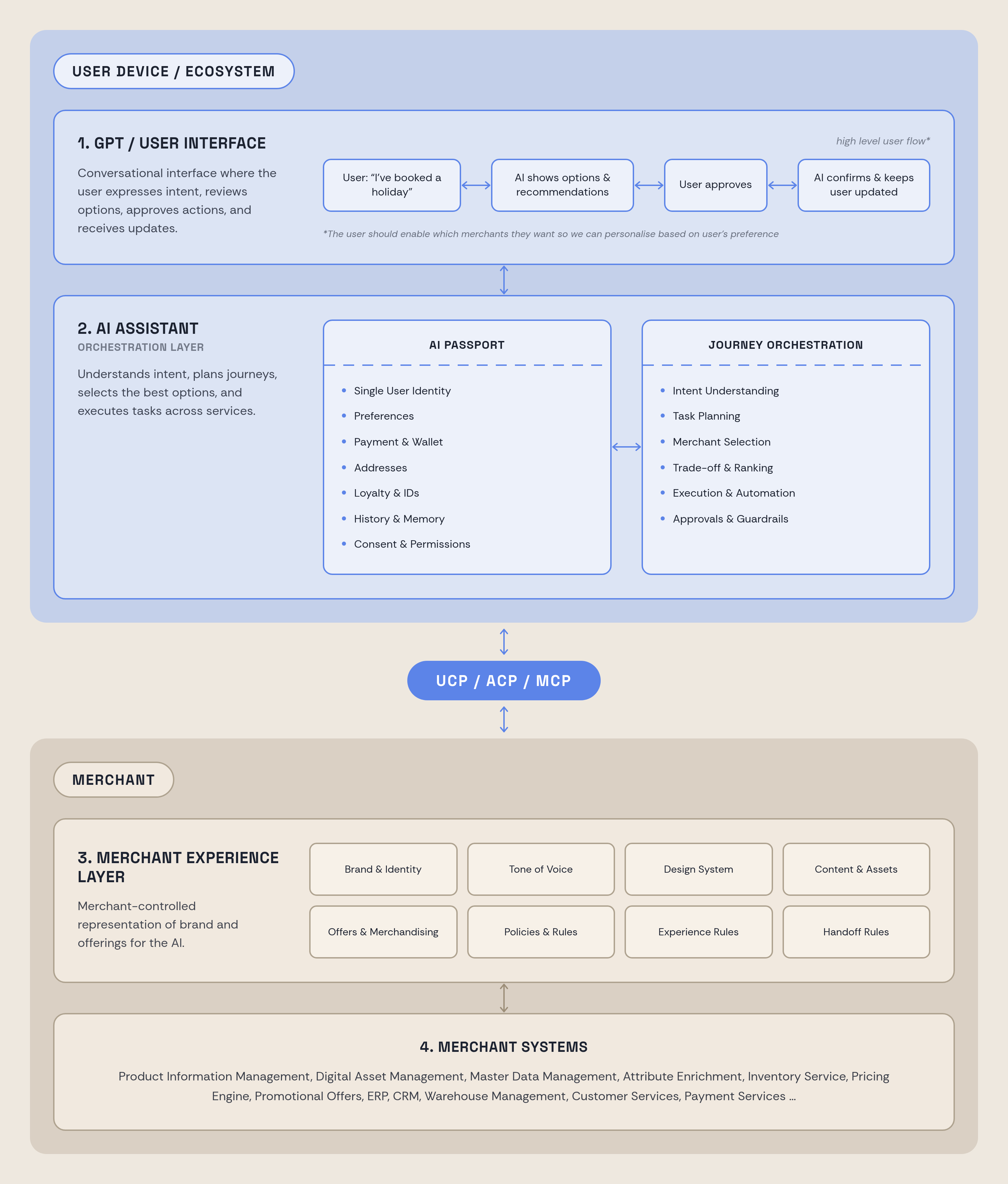 The customer expresses intent in a conversational UI, an AI assistant (with an “AI passport” of identity, preferences, wallet, and permissions) plans and orchestrates tasks, connects to merchant systems via standard protocols (UCP/ACP/MCP), and executes through a merchant-controlled experience layer backed by the merchant’s operational ecosystem (PIM, inventory, pricing, ERP, CRM, payments).
This is the prize and the threat in equal measure. For the customer, it is a life with dramatically less friction and cognitive overhead. For the retailer, it raises an urgent question: are you a service the agent can reach, understand and trust enough to weave into these orchestrated journeys — or are you invisible to the very intelligence now coordinating your customer's day? In an orchestrated life, the retailers that win are the ones that are easy to plug in, reliable to act on, and valuable enough that the agent reaches for them again and again.
Yet beneath every one of these orchestrated actions sits a single, non-negotiable foundation: trust. The customer must be willing to share the most intimate signals of their life — where they are, when they are away, what they buy, how they pay and who they live with. That only happens if they trust their data is secure, that the agent acts in their interest rather than the highest bidder's, that it will not over-step, mis-spend or expose them, and that clear consent, guardrails and control exist at every step.
Without that, the customer simply will not hand over the keys to their life, and the entire agentic model collapses back into the manual, fragmented effort it promised to remove. For retailers, this raises the stakes once more: being machine-readable and reachable counts for little if the broader ecosystem — the agent, the platform and every connected service — has not earned the right to act on a customer's behalf. Trust is the currency that makes the orchestrated life possible, and it is the first thing lost the moment any link in the chain mishandles it.
Where Does That Leave Retailers?
This is the uncomfortable question. If the customer's first interaction is with an agent rather than a retailer, the retailer is no longer guaranteed to own discovery, comparison, the interface, or — in some cases — even the checkout. It becomes one possible answer inside an agent's decision-making process, and that changes the rules of competition entirely. In the old world, retailers competed for traffic; in the new world, they will compete for recommendation.
The agent will not only ask "Who sells this product?" but "Who is the best retailer to fulfil this customer's intent, given everything I know about the customer, the context and the trade-offs?" That is a far harder game to win.
When an agent is deciding on a customer's behalf, it looks for clear reasons to choose one retailer over another. One winning route is value and operational excellence — retailers who win because the product, price, availability and fulfilment promise are unambiguously strong. The other winning route is experience, trust and curation — retailers who win because the brand, service, advice, quality assurance and relationship matter deeply, making them trusted experience curators rather than mere product providers.
The challenge falls on everyone in between. If a retailer is not the cheapest, convenient or fastest, and not the most trusted or most curated, why would an agent ever choose it?
Two Jobs for the Retailer
In the agentic landscape, retailers will need to do two jobs at once. The first is to become agent-readable with the right data and policies all through a reliable context layer. This is the functional element that allows an agent to determine whether the retailer is a good answer in the first place.
The second job is to remain humanly desirable. This is the experiential layer mixing brand, tone and inspiration, and it is what gives the customer a reason to care. The best retailers will know how to connect the two, exposing enough structured information for agents to recommend them while creating enough brand value for customers to want a deeper relationship.
What Retailers Need to Do Now
The work starts with being brave and getting started. The approach to supporting both these approaches is complementary at a technology and culture level - getting comfortable with how agents (either external or internal) navigate your data and workflows and represent your brand.
Agents are most useful when armed with structured, accurate, rich and contextual product information; a thin product title and a few generic attributes will not cut it. A retailer's context layer will need data that explains what a product is, who it is for, and why it should be trusted. That has to be matched by real-time operational data, because before an agent recommends a retailer it needs confidence that the product is in stock, the delivery promise is accurate, the price is current, the promotion is valid and the return policy is clear. APIs matter just as much: slow, brittle or incomplete integrations will become commercial liabilities in a world of agent-to-system interaction, where retailers must be easy to query, understand and transact with.
Our advice is to explore either or both options right now, what you learn and prove in the business will ultimately be complementary (much like the examples mentioned above) that can be reused to accelerate the other approach.
Fundamentally this is about strategic choices and who you are as a brand, and how you respond to customer intents. Retailers need to build an intent model that understands the missions customers are trying to complete, the stages they move through, the signals that reveal whether they are browsing or buying, and the moments that matter where a brand should step in with education, reassurance or human expertise. The defining question is no longer "What products do we sell?" but "What customer intentions are we best placed to fulfil?"