Drastically Accelerating Route for Drugs into Safe Human Trials with AI-powered Deep Research
source hallucination rate
scientific novelty score
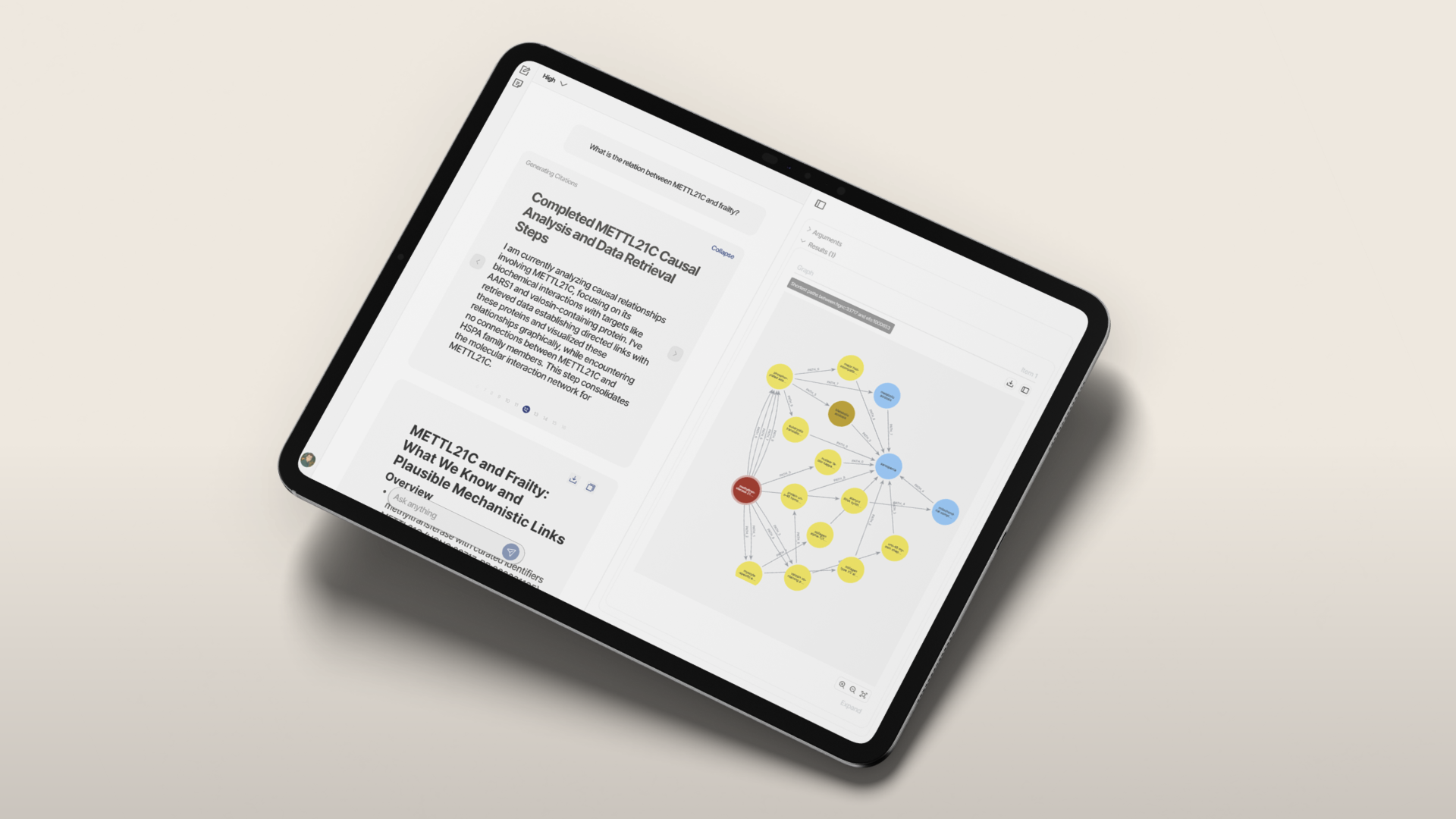
- A global pharma giant needed to accelerate drug target discovery by uncovering hidden gene–disease relationships and reducing the time needed to bring safe treatments into human trials.
- Tomoro built an agentic deep-reasoning system using GPT-5 and GPT-5-mini that integrates biomedical literature, omics data, and assays, delivering a production-ready platform in just 12 weeks.
- The solution achieved 0% source hallucination, an 89% scientific novelty score, and empowered researchers to generate new hypotheses faster, cutting months from early-stage research and paving the way for AI-driven pharmaceutical innovation.
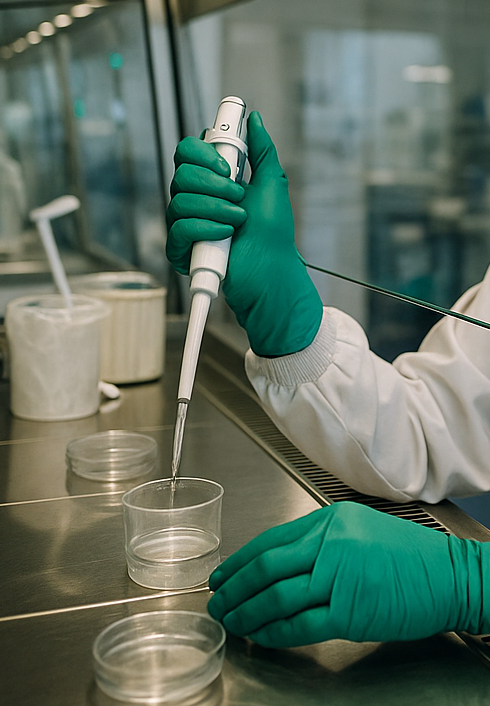
The first step in developing any new treatment sounds straightforward although is anything but. Drug target discovery is the process of identifying the biological “switches” that influence disease. It involves finding the genes, proteins or molecular pathways that, if altered, could halt, slow or even reverse illness.
Drug target discovery underpins everything that follows in pharmaceutical development. Without a viable target, there is no therapy. The challenge is not a lack of data but the cognitive load and time it takes to go through complex literature to find what they need. The information exists, but the volume of potential targets is enormous meaning researchers can go through many failures before finding a successful target.
Enabling researchers to make more informed decisions around what potential drug targets to investigate further and increase the percentage of successful targets, reducing the time from hypothesis to trials.
One of the world’s largest pharmaceutical companies realised that if it could change how it uncovered hidden connections in this data, it could accelerate its path to discovery.
Pushing the Boundaries of Biomedical Research
The company set out with a bold vision to harness AI and identify novel gene–disease relationships faster and explore the effects of complex, multi-gene interactions rather than focusing only on direct links.
By integrating knowledge from literature, complex biological datasets (omics data) and assays (analysing the composition and quality of substances) into a unified research environment, the pharma giant wanted to give researchers a system that could generate new hypotheses, suggest promising directions and keep pace with human curiosity.
With the entire solution built on an adaptable platform that could shift seamlessly across therapeutic areas, researchers would have more than just a search tool but a partner in discovering new drug targets with greater effectiveness.
A Tangled Web of Biology Data
The obstacles for such an ambitious project were significant. Researchers faced an overwhelming deluge of information, with thousands of scientific papers and complex datasets that exceeded what any human team could reasonably process in an acceptable timeframe. The terminological inconsistency across biomedical literature, where identical concepts might appear under different names across various sources, made reliable information retrieval exceptionally difficult.
Technical hurdles were equally daunting. The system needed to seamlessly connect with bespoke APIs, interpret complex omics data, process laboratory assay results, and navigate massive knowledge graphs – all requiring custom integration work. When large language models were applied to these tasks, they frequently produced queries that never ended, delivered irrelevant results, or suffered from performance delays.
Unlike many AI projects where accuracy might be the primary metric, this system needed to demonstrate the ability to surface genuinely new insights rather than merely regurgitating established knowledge. This meant novelty was just as critical a success metric as accuracy.
Finally, before any wider deployment into a highly-regulated enterprise environment, the solution required enterprise-grade security and robust authentication protocols to ensure safety at scale.
This project extended far beyond simply refining an existing system. It’s a fundamental rethinking of how to augment human researchers with AI in the complex domain of biomedical discovery.
Developing an Agentic System for Deep Reasoning
The answer, built using and run using GPT-5, took shape as a system of AI agents, each performing a specific role in the research process.
- Prompt Expansion broadened narrow queries into richer searches, for example turning “frailty” into related terms like muscle wasting, inflammation or sarcopenia.
- A Lead Planner Agent broke down complex biological questions into smaller parts.
- Sub-Planner Agents launched networks of Research Agents that pursued questions in parallel, adjusting direction dynamically.
- Execution Agents connected directly with biomedical datasets, APIs and knowledge graphs.
- Chain of Debate means models take on different personas and debate with each other to produce more full and rounded answers. For example, a model proposes hypotheses, another is prompted to role play and challenges the report arguing it's not being innovative enough, another argues there's not enough evidence and to search for more; and lastly an agent challenges it through the lens of what would make sense in the context of the organisation’s strategy. This is then used to update the direction of research.
- An Update Planner continuously aggregated results and adjusted research direction in real time.
The architecture was supported by strict anti-hallucination checks to ensure every claim could be traced back to a verified source.
Behind the scenes, a number of technical innovations made the system robust:
- Custom semi-structured APIs designed for stability.
- Integration of the client’s Named Entity Recognition tool to resolve inconsistent terminology.
- Budget controls to prevent wasteful, continuous searches.
- Compute expansion modules capable of inferring indirect biological links such as gene to inflammation to frailty.
- Automatic context management to handle large research traces.
The result was an AI system able to navigate the complexity of modern biology with speed and precision.
From Proof to Practice, in Twelve Weeks
A prototype was delivered in two weeks - within twelve, the system was live and in active use. Our deep reasoning agentic system:
- Retrieves information and reasons across five key biomedical datasets.
- Uncovers novel, indirect biological connections that traditional tools missed.
- Scores 89% for scientific novelty in early benchmarks, surpassing public deep research endpoints. This is quantified by evaluating how the system drew connections between different sources of information. Inferences and connections were evaluated using an LLM-as-judge method on a set of curated research question-answer pairs.
- Equips researchers not just to find information faster, but to generate new hypotheses.
The platform has the potential to shorten the time needed to generate viable hypotheses and identify targets for drug discovery. In doing so, it can significantly reduce the time to bring safe human trials and make potentially life-saving treatments available.
A Roadmap for More Complex Reasoning
This system continues to evolve. We plan for the solution to incorporate even more data sources and are using techniques such as reinforcement learning to train specialised models that can retrieve and reason more effectively over this data.
Drug target discovery remains one of the hardest and most uncertain frontiers in science. With AI-powered systems that can process complexity at scale and work alongside human researchers, that becomes a little less daunting.
Our solution creates a repeatable model for other highly regulated industries that rely on complex and disparate research, showing how AI can deliver breakthroughs in a matter of weeks.
24th October 2025
Turn AI into your competitive advantage.
Contact UsSolve the hardest problems in AI.
Join Us